Medical Coding Governance Platform
Deterministic Safeguards Over Probabilistic AI
LexiFab ensures clinical data integrity by acting as a governance layer over AI-generated medical codes. Where Large Language Models guess, LexiFab verifies — delivering audit-quality precision through structured ontologies, transparent logic, and human-validated protocols.
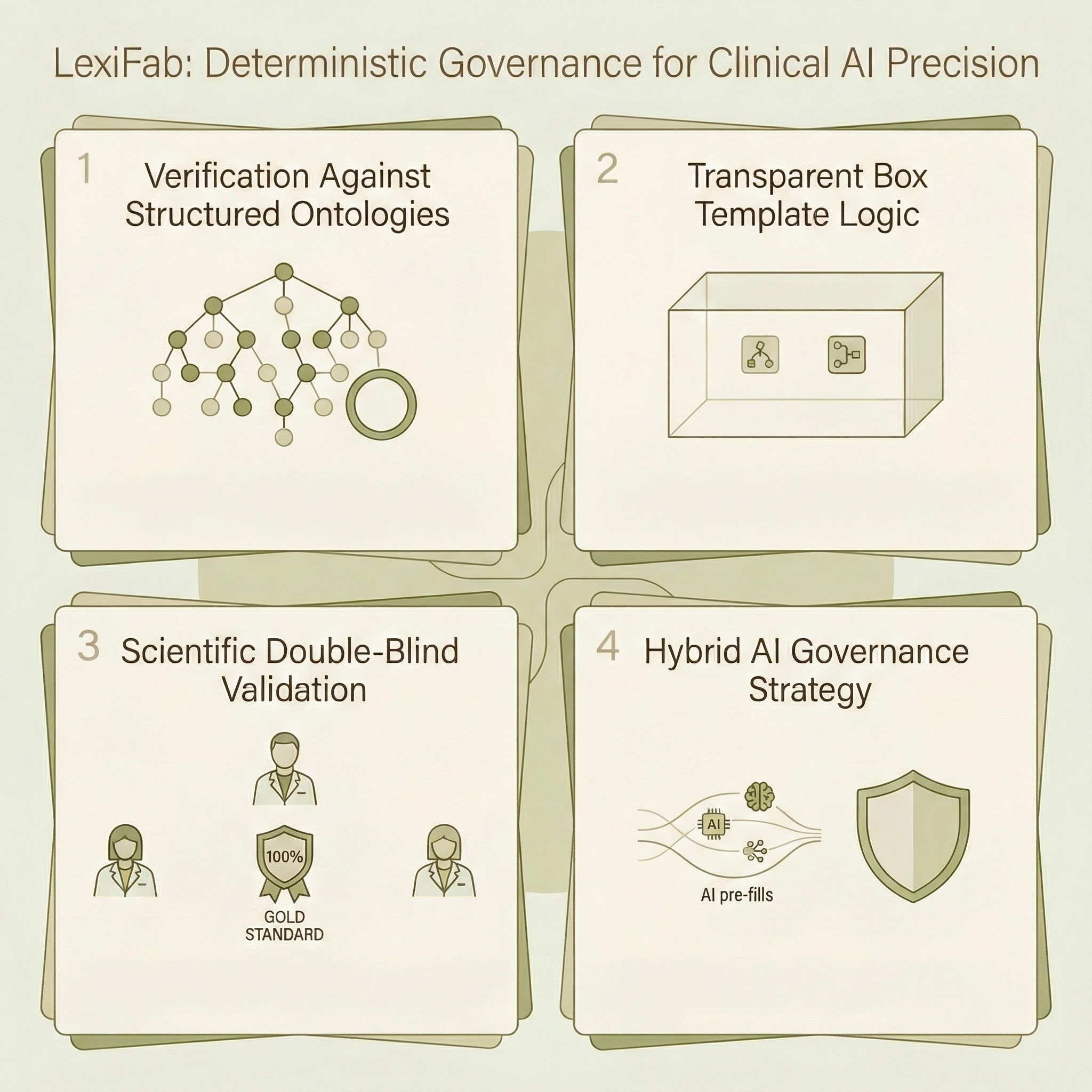
Deterministic Governance for Clinical AI Precision
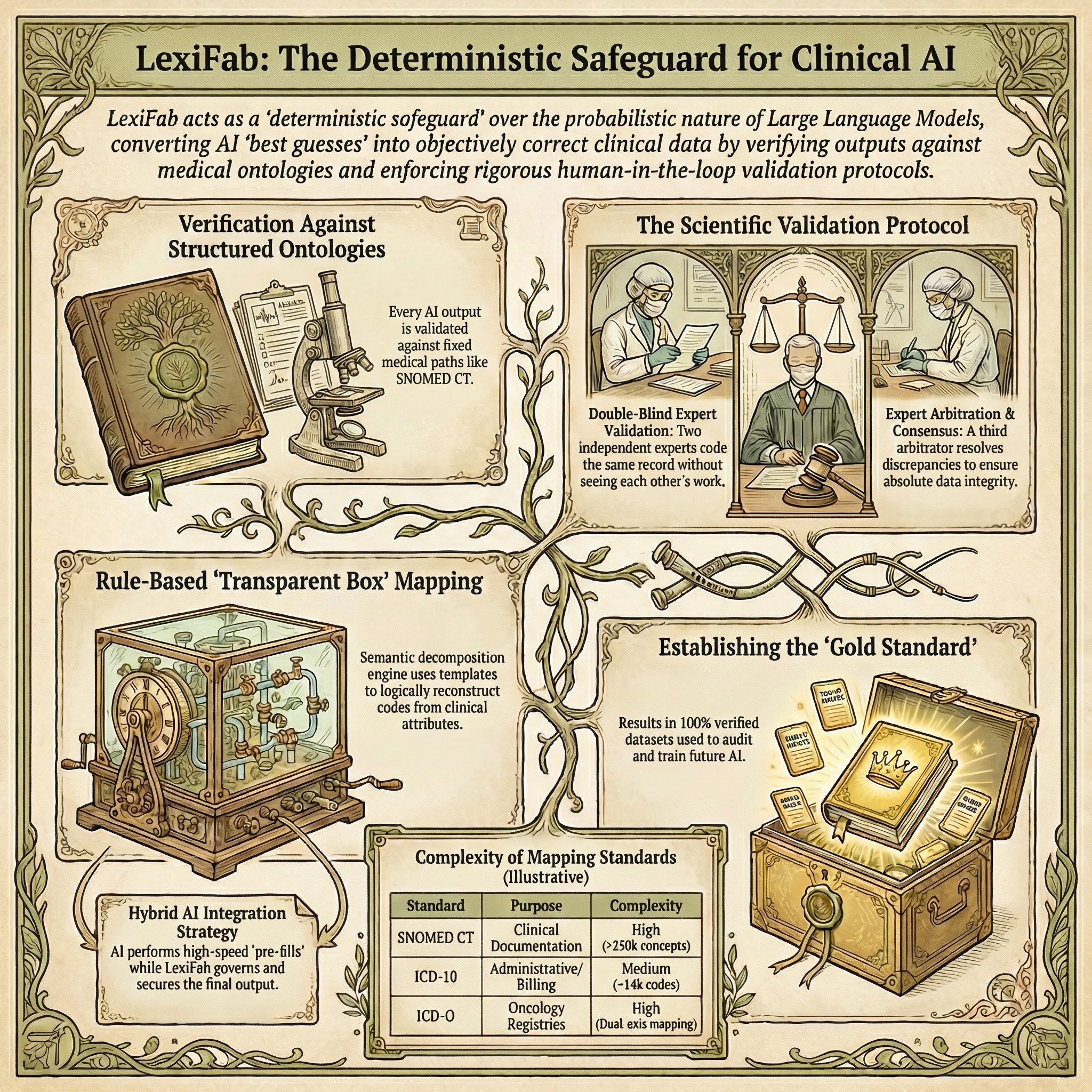
LexiFab prevents AI hallucinations by acting as a deterministic safeguard and governance layer over the probabilistic nature of artificial intelligence. While LLMs operate on best guesses, clinical data requires objectively correct, deterministic precision.
Verification Against Structured Ontologies
AI models can generate codes that look plausible but are clinically invalid. LexiFab prevents this by verifying that any suggested output corresponds to a valid, structured path within established medical ontologies such as SNOMED CT. Because terminologies do not hallucinate, LexiFab uses these fixed structures to constrain and validate AI output.
Transparent Box vs. Black Box
Unlike black-box AI systems, LexiFab is a transparent box for terminologists. It uses a sophisticated template system that analyzes clinical attributes like topography and morphology to logically reconstruct the correct code, employing a semantic decomposition engine that follows strict rules to ensure deterministic mappings.
Human-in-the-Loop Validation
LexiFab employs rigorous scientific protocols: double-blind validation where two independent experts code the same record without seeing each other's work, with expert arbitration to resolve discrepancies. This creates a Gold Standard dataset with 100% data integrity verified by human consensus.
Hybrid Integration Strategy
Designed to integrate with AI by allowing an LLM to perform a first pass or pre-fill of coding templates. LexiFab then governs that output, forcing the AI's probabilistic suggestions into a coherent, multi-classification structure that meets audit-quality standards.
Architecture & Template Logic
LexiFab's multi-classification template architecture resolves complex semantic interoperability challenges by addressing fundamental issues like granularity discordance and multi-target classification, which often defeat simpler mapping systems.
Hub-and-Spoke Semantic Architecture
LexiFab positions the rich SNOMED CT ontology (over 350,000 active concepts) as the central hub. From a single SNOMED-based input, it can simultaneously generate outputs for several distinct target terminologies including ICD-10, ICD-O (Oncology), ICPC (Primary Care), and ICHI (Health Interventions) — enabling a "code once, report everywhere" workflow.
Resolving Granularity Discordances
Mapping from SNOMED's highly specific ontology to general classifications like ICD-10 (only ~14,000 codes) often results in data loss. LexiFab's template system manages many-to-one and many-to-many logic that simple mapping tables cannot handle.
Combinatorial Template Approach
In complex fields like oncology, a single SNOMED code may not contain enough information for a precise ICD-O code. LexiFab allows combining multiple SNOMED codes within a template — for example, combining "Invasive ductal carcinoma" with "Upper outer quadrant of the breast" to construct the required ICD-O output.
AI Integration Layer
LexiFab integrates with AI for automated pre-coding tasks while providing a deterministic governance layer over the probabilistic nature of AI. The platform accepts AI-generated inputs and manages them through rigorous validation workflows.
Pre-filling Templates via LLM
Modern Large Language Models can pre-fill LexiFab's sophisticated templates via API. The AI performs the high-speed first pass of coding, while human experts use double-blind validation protocols to manage low-confidence exceptions and ensure audit-quality precision.
Ontological Safeguard
Because AI and LLMs are probabilistic and can hallucinate, LexiFab serves as a safeguard that verifies the AI's output corresponds to a valid, structured path within the medical ontology, ensuring the final data is coherent and deterministic.
Gold Standard Training Data
LexiFab produces 100% validated consensus data through its arbitration process, serving as a Data Factory for creating the high-quality Gold Standard corpora necessary to train and audit medical AI models.
The Gold Standard Protocol
The double-blind validation process is a rigorous scientific protocol designed to ensure the highest possible level of data integrity and precision when mapping clinical documentation to medical classifications.
Independent Coding (Double-Blind)
Two clinical coders work independently on the same medical record. They perform this task without any visibility into each other's work, preventing bias or influence.
Discrepancy Identification
The system compares the results of the two independent coders to identify divergences — areas where the chosen codes do not match.
Arbitration & Consensus
When a conflict is identified, a third independent validator (the arbitrator) examines the case, reviews the original clinical data and both conflicting entries to establish a final, unified decision.
Audit-Quality Accuracy
Provides a deterministic result rather than a best guess, essential for institutional registries such as cancer registries and state-level clinical reporting.
Scientific Norms
This protocol has become the normative standard for high-quality terminology work in academic and research settings, including those overseen by schools of public health.
AI Training Data
Validated datasets serve as Gold Standard corpora for training and auditing medical AI and Large Language Models, providing ground-truth data that probabilistic models cannot generate on their own.